In thin sheet, acceleration beats power — and most shops still buy the wrong axis
Below about 3 mm the beam is rarely the limit. Cycle time is set by how fast the gantry can change direction, and by how quickly parts leave the table.
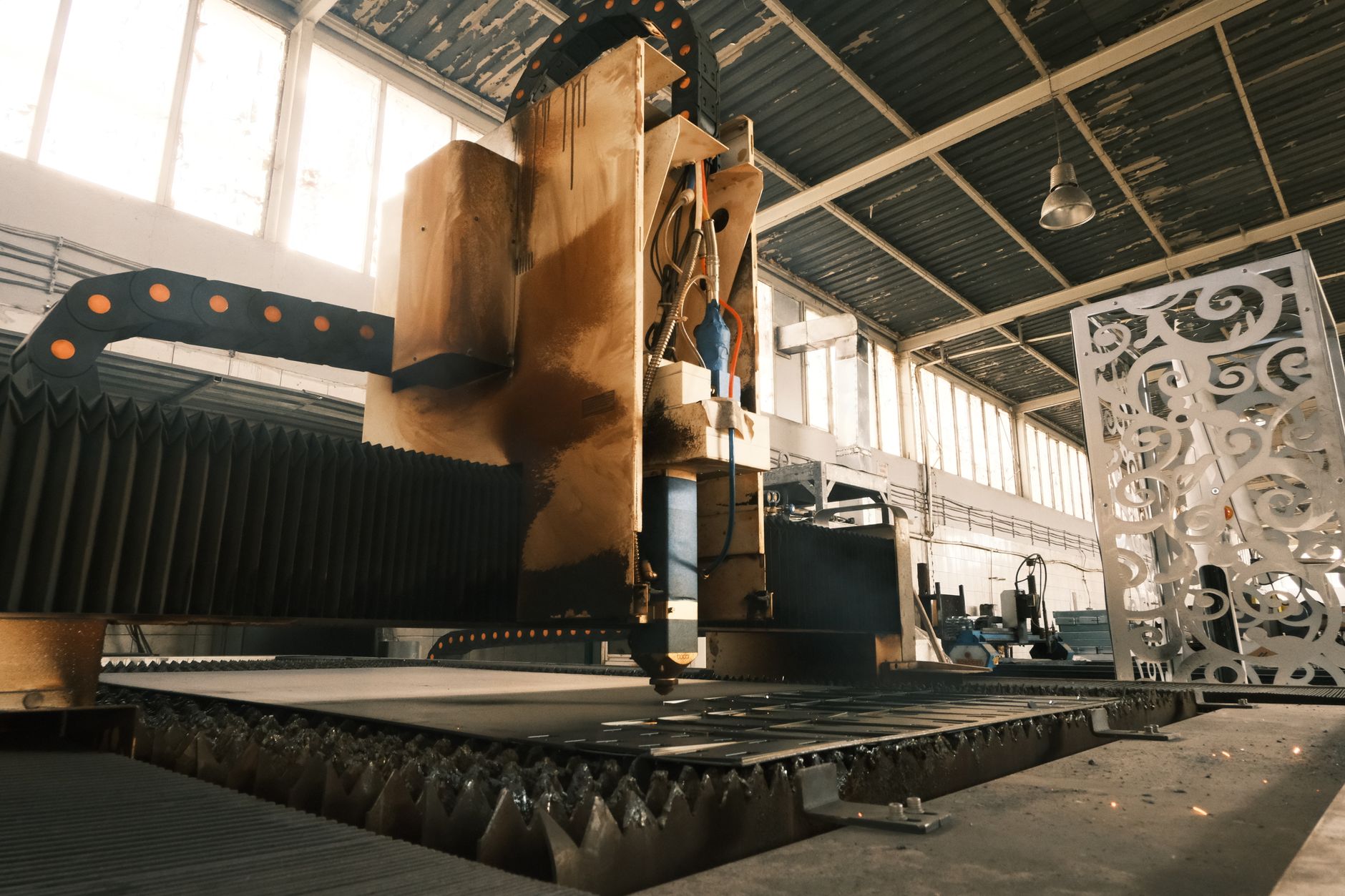
A 12 kW machine cutting 1.5 mm mild steel is not power limited. It is limited by how quickly the motion system can accelerate into a corner, decelerate, reverse and accelerate out again. Yet thin-gauge shops routinely specify source power as though it were the governing variable.
Where the seconds go
Consider a typical thin-sheet part: a panel with mounting holes, louvres and a perimeter with several corners. The straight sections run at whatever feed the cut chart allows, and on thin material that feed is very high. Almost none of the cycle is spent there. The time goes into the hundreds of acceleration and deceleration events, into piercing each hole, and into the rapid moves between features.
Doubling source power shortens the straight-line segments that were already the fast part. It does nothing for the rest.
What actually helps
Motion dynamics. Linear drives, lower moving mass and higher jerk limits reduce the corner penalty directly. The specification worth comparing is acceleration in g, not watts.
Piercing strategy. On a part with forty holes, pierce time can exceed cut time. Fast-pierce routines, and on thin material pierce-on-the-fly approaches, remove a large block of the cycle.
Automation. Once the cut cycle is short, the table exchange and part removal become dominant. A machine that cuts a sheet in ninety seconds and takes sixty to swap it has an automation problem, not a laser problem.
The specification consequence
The useful question for a thin-gauge buyer is not "how thick can it cut" but "what is the cycle time on my actual part". Machine builders will run that benchmark on request, and the results frequently surprise buyers who assumed a bigger source would help.
None of this argues against power. It argues for matching the specification to the work. A shop cutting 20 mm plate should buy watts. A shop cutting 1.5 mm panels should buy acceleration, piercing performance and a fast table — and should spend the difference on material handling.
This article was produced by the LasersNews AI desk and reviewed by our editors.
Related reading
From Kilowatts to Control: How Adaptive Optics and Gas Dynamics Redefine Laser Cutting Economics
Industrial fiber laser cutting shifts from raw power to integrated sensor control, dramatically improving fir…

Intelligent Cutting Heads and Algorithmic Nesting Redefine Laser Cost Per Part
Adaptive optics, dynamic focus, and AI-driven nesting are lowering scrap rates and optimizing cost per part i…
Bevel cutting heads move from specialist tool to mainstream fabrication kit
Five-axis cutting heads that were once reserved for heavy structural work are appearing on general-purpose fl…