Annealing marks keep the surface intact, which is exactly why medical buys them
Heating stainless just enough to grow a coloured oxide leaves the passive layer and the geometry untouched. Get the temperature wrong and you have created a corrosion site.
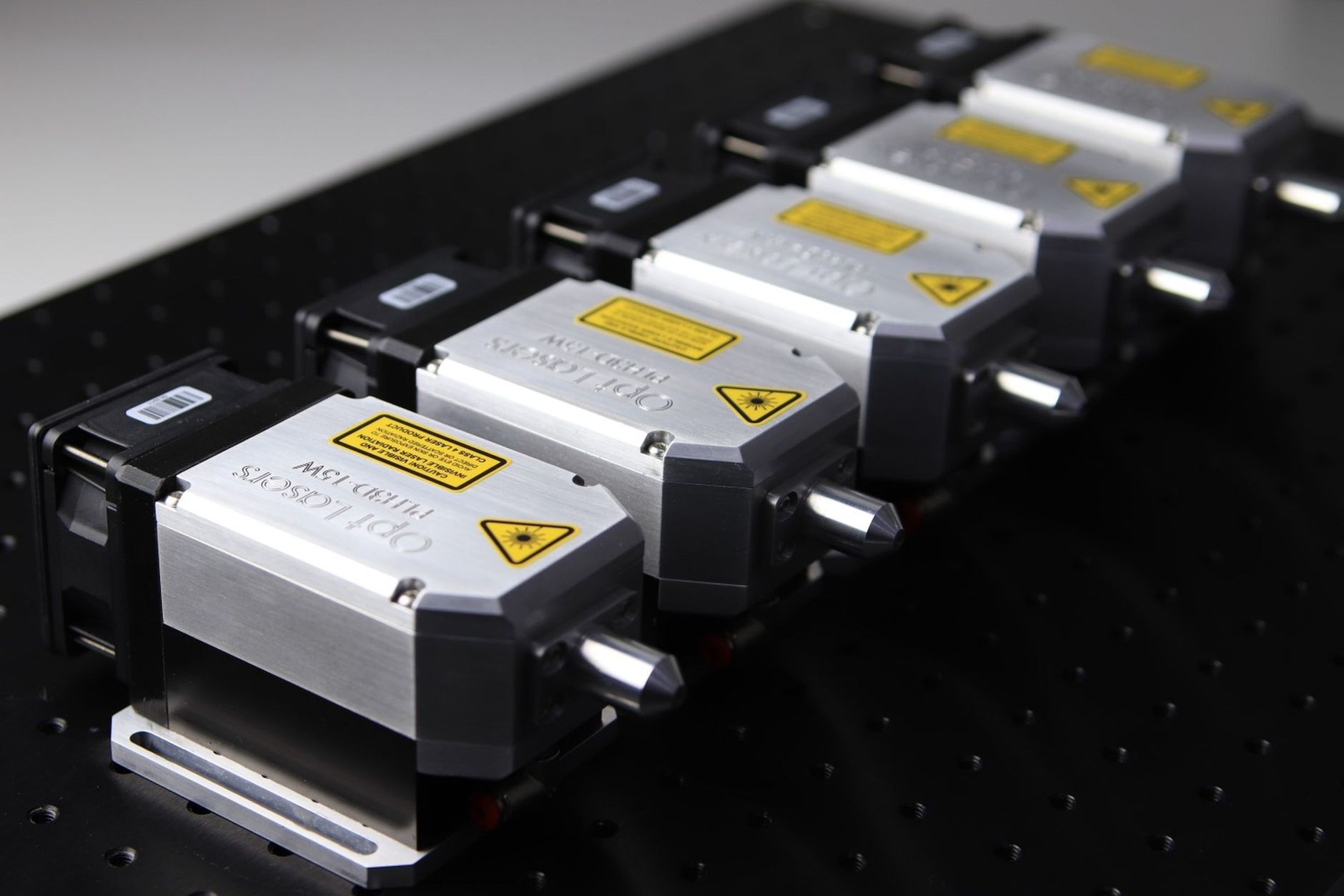
An annealing mark is not engraved. The laser heats the metal surface below its melting point, an oxide layer grows, and interference in that layer produces a colour ranging from straw to black depending on thickness. No material is removed, and the surface stays smooth.
Why surgical instruments use it
A surgical instrument must be cleanable. Any engraved recess is a place where biological material can lodge and survive cleaning, which is why marking standards for reusable instruments favour marks with no topography.
The instrument must also resist corrosion through repeated autoclave cycles. Stainless steel achieves that through a thin chromium oxide passive layer, and anything that disrupts that layer creates a preferential corrosion site.
An annealing mark, done correctly, leaves both properties intact.
The narrow window
Done incorrectly, it does the opposite. Excessive heat input drives chromium depletion near the surface as chromium carbides form, leaving a chromium-poor region that no longer passivates. The visible result may be an attractive dark mark; the invisible result is a stripe that rusts after a few dozen cycles.
The controlling variables are peak temperature and time at temperature, which in practice means pulse energy, repetition rate, hatch spacing and scan speed acting together. The parameter set is material specific, and a set validated for one stainless grade does not transfer to another.
Verification
Because the failure mode is invisible at production time, qualification relies on accelerated corrosion testing of marked samples, and production relies on parameter lockdown and monitoring. Some manufacturers include a marked coupon in each sterilisation validation batch.
Beyond medical
The same approach appears wherever surface integrity matters more than mark depth: fatigue-critical aerospace parts, food contact equipment, and increasingly on stainless consumer products where a smooth marked surface is an aesthetic requirement.
The engineering lesson generalises. A process that removes no material seems inherently gentle, but the metallurgical change it induces can be more consequential than the material an engraving would have removed.
This article was produced by the LasersNews AI desk and reviewed by our editors.
Related reading

Traceability rules quietly reshape what a marking system has to do
Permanent part identification is no longer a finishing step — it is a data problem that happens to involve a…

UV marking found its place where heat is the enemy
At 355 nm the mark comes from breaking molecular bonds rather than melting. For plastics, glass and thin coat…
Traceability rules are now writing the marking specification
UDI, aerospace part marking and battery passports each demand a code that survives the product's life. Perman…