Welding galvanised steel is a venting problem with several accepted answers
Zinc boils below steel's melting point. Every practical method for lap welding coated sheet is a way of giving that vapour somewhere to go.
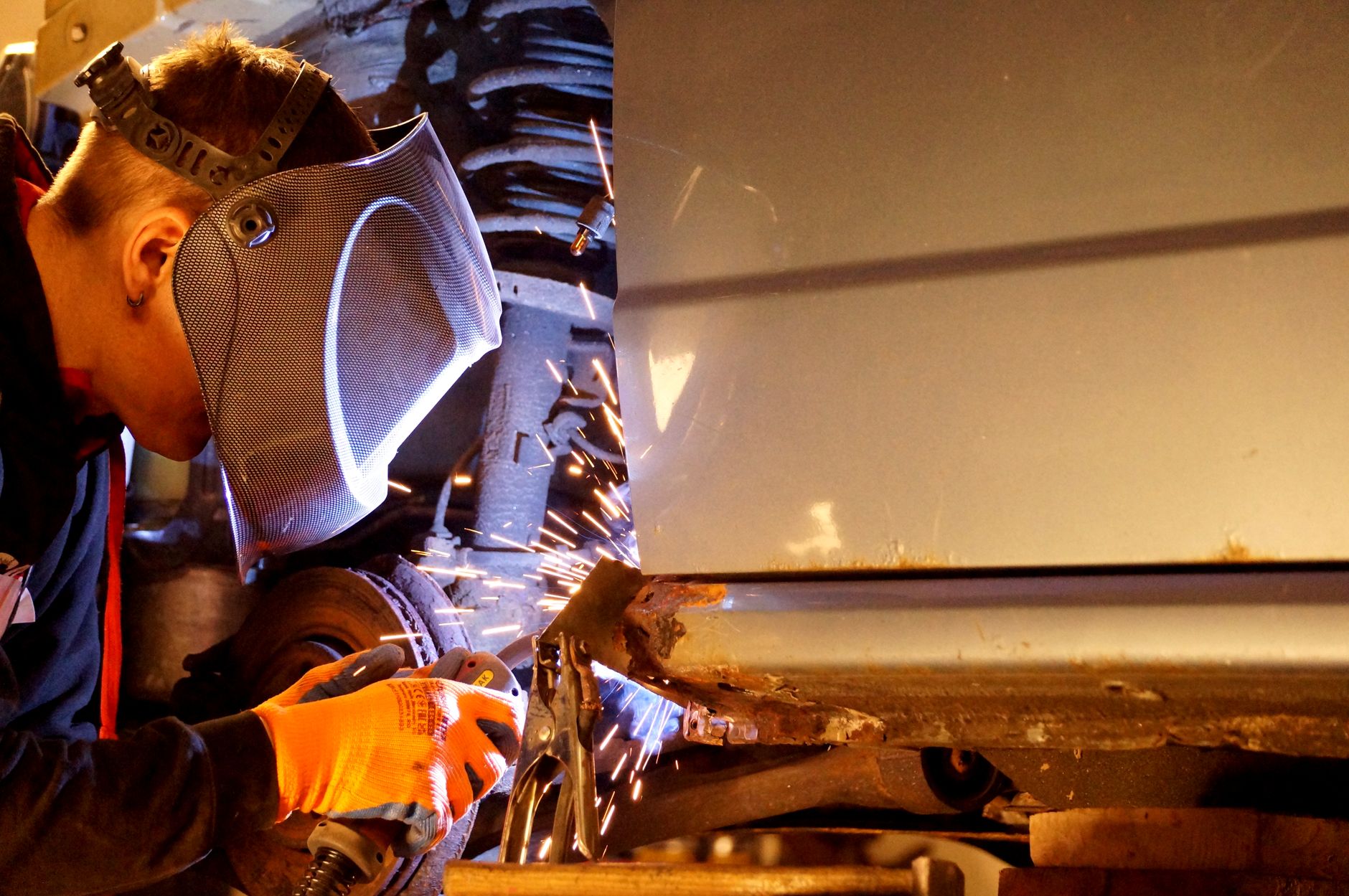
Zinc vaporises at around 900 °C, well below steel's melting point. Welding a lap joint in galvanised sheet therefore generates zinc vapour at the interface, inside a closed cavity, with the only exit through the molten pool. The result is expelled melt, severe spatter and porosity.
Every working method addresses the same problem: create a path for the vapour.
Mechanical gap
The traditional answer is a controlled gap between sheets, typically 0.1 to 0.2 mm, created by dimples pressed into one sheet, laser-formed bumps, or shims.
It works reliably. The cost is a forming operation and a gap that must be held: too small vents inadequately, too large prevents bridging. Across a large assembly, maintaining that gap uniformly is the difficulty.
Beam-created vent
A first pass with the laser can create a groove or perforation in the top sheet ahead of the weld, giving vapour an escape route. This avoids a separate forming operation but adds process time and requires precise coordination.
Dual-beam and beam shaping
Splitting the beam so a leading spot preheats and vaporises zinc ahead of the main weld allows vapour to escape before the pool closes over it. Beam shaping approaches — ring modes, elongated spots — extend the pool geometry so vapour escapes at the trailing edge rather than through the weld.
These avoid mechanical preparation entirely, at the cost of process development and equipment capability.
Coating removal
Stripping zinc from the weld zone before joining eliminates the problem, and reintroduces a corrosion path at the joint. Acceptable in some applications, unacceptable in automotive body work where the coating is the point.
Choosing
Volume decides much of it. High-volume automotive production justifies the process development for beam-based approaches. Lower-volume fabrication generally finds mechanical gapping simpler and more robust.
What does not work is treating galvanised steel as ordinary steel and adjusting parameters. That produces a weld that looks marginal, sprays spatter across the cell, and fails inspection — and it is where most projects with coated material start.
This article was produced by the LasersNews AI desk and reviewed by our editors.
Related reading
Shift Toward Data-Driven Beam Modulation and Closed-Loop Monitoring Reshapes Laser Welding
Advanced beam modulation and real-time monitoring are transforming laser welding from a manual craft into a p…

Remote Laser Welding Systems Converge on Dynamic Beam Shaping and Closed-Loop Monitoring
Advanced remote laser welding systems are merging dynamic beam shaping with real-time optical monitoring to m…

Handheld laser welding grows up as fume, safety and training catch up to the hardware
The tool that upended small-shop fabrication is now facing the unglamorous engineering work that decides whet…