Titanium welding is atmosphere control with a heat source attached
Above about 400 °C titanium absorbs oxygen, nitrogen and hydrogen from air, and the resulting embrittlement is invisible until the part fails.
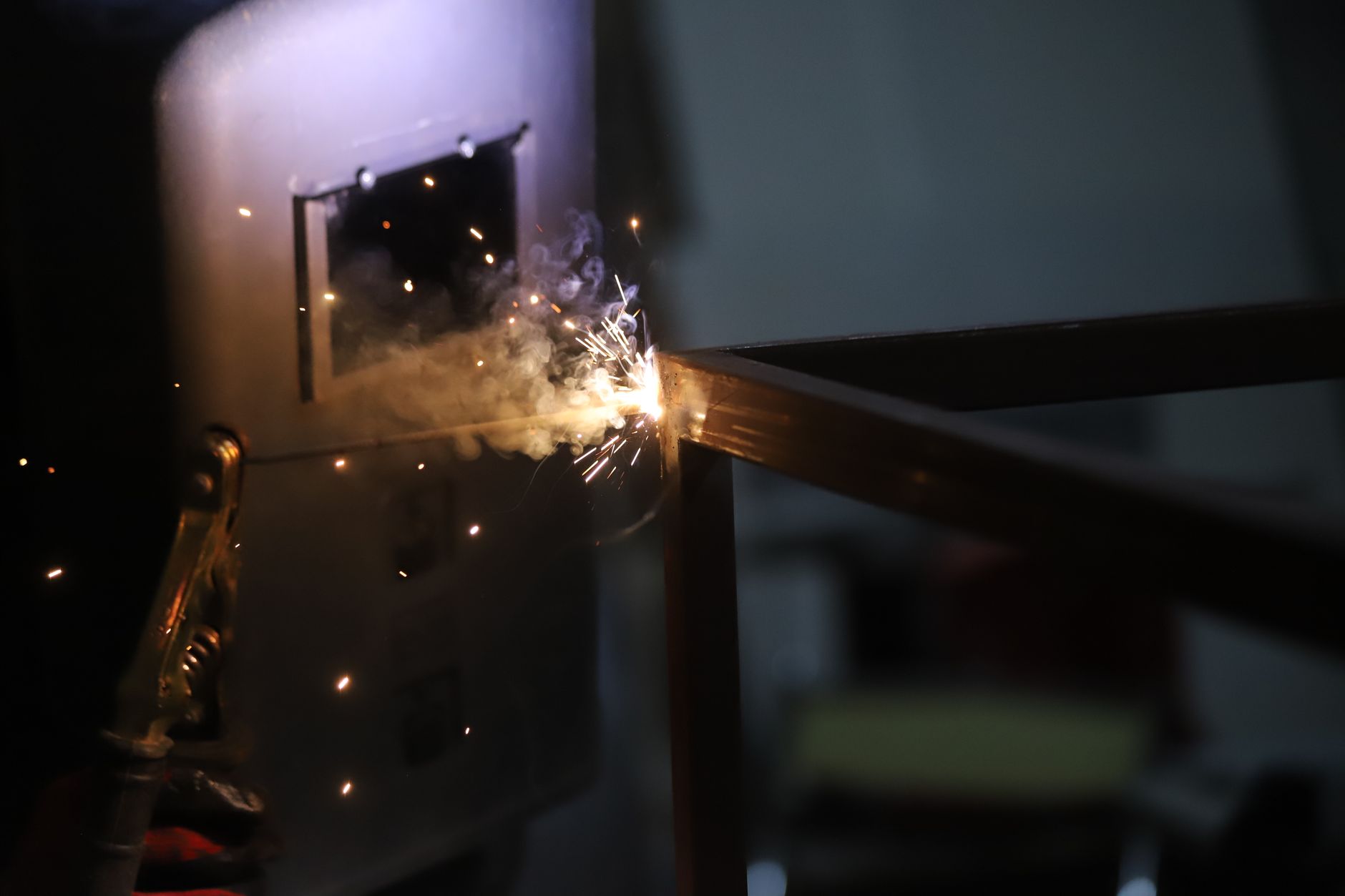
Titanium's attraction — strength to weight, corrosion resistance, biocompatibility — comes with a welding requirement that dominates every other consideration. Hot titanium is chemically aggressive toward the atmosphere, and contamination it picks up during welding cannot be removed afterwards.
The contamination mechanism
Above roughly 400 °C, titanium absorbs oxygen, nitrogen and hydrogen readily. These dissolve interstitially in the metal lattice and raise hardness while sharply reducing ductility and fracture toughness.
The affected material is not a surface layer that can be machined away in any practical sense; contamination penetrates. And the property change is not visible in a dimensional or visual inspection.
The colour indication and its limits
Surface discolouration gives an indication: bright silver is clean, light straw is marginal, and blue, grey or white powdery surfaces indicate progressive contamination. Standards use this as an acceptance criterion.
It is a useful field indicator and an imperfect one. Colour reflects surface oxide, and a weld can be adequately coloured while having absorbed hydrogen, which produces no colour change at all.
What adequate shielding requires
Trailing shields. The weld remains above the reaction temperature well behind the beam, so shielding must cover the cooling weld, not just the pool. Trailing shields extend coverage along the joint.
Back purging. The root side needs the same protection as the face.
Chamber welding. For critical work, welding inside a purged enclosure removes the geometry problem entirely, at the cost of throughput and part size limits.
Cleanliness. Hydrogen comes from moisture, oils and fingerprints. Preparation and handling discipline matter as much as gas coverage.
Where laser helps
The narrow heat-affected zone and rapid travel reduce the time any given point spends above the reaction temperature, which shrinks the region needing protection. That makes shielding geometry more tractable than in slower processes.
It does not remove the requirement. Projects that treated titanium as ordinary stainless with a different parameter set have produced parts that passed every dimensional check and failed mechanical testing — which is the expensive way to learn that the atmosphere, not the beam, was the process.
This article was produced by the LasersNews AI desk and reviewed by our editors.
Related reading
Shift Toward Data-Driven Beam Modulation and Closed-Loop Monitoring Reshapes Laser Welding
Advanced beam modulation and real-time monitoring are transforming laser welding from a manual craft into a p…

Remote Laser Welding Systems Converge on Dynamic Beam Shaping and Closed-Loop Monitoring
Advanced remote laser welding systems are merging dynamic beam shaping with real-time optical monitoring to m…

Handheld laser welding grows up as fume, safety and training catch up to the hardware
The tool that upended small-shop fabrication is now facing the unglamorous engineering work that decides whet…